Ethics, Evidence, and Salt

salt shakerOne of the biggest problems for consumers hoping to choose foods wisely (and for regulators hoping to help consumers in that regard) lies in the difficulty in getting good, clear advice.

Even salt (discussed in yesterday’s posting as well) is more complicated, health-wise, than most people realize. Most people take it as given that salt is bad for you. It’s one of those things that “everyone knows,” and that most people lament. But the science, for better or worse, is not so clear.

See this piece, from the Financial Post: Junk Science Week: Salt scare lacks solid evidence (the piece is by David McCarron, University of California, Davis)

McCarron discusses…

…two critical flaws in the science.

The first relates to the established fact that only a minority of individuals’ blood pressure is sensitive to salt. For the majority, there is no change when salt is reduced and for some their blood pressure will go up. The latter is not a theoretical possibility. The past president of the International Society of Hypertension recently sounded a note of caution in an editorial in the Journal of the American Medical Association. Dr. Michael Alderman, citing data from peer-reviewed articles in the medical literature, documented that it is quite unclear whether reducing sodium intake improves health outcomes, has no effect or causes harm….

The second problem, according to McCarron, lies in the assumption “that public policy pronouncements and intimidation to force a reduction in the salt content of food can in fact result in our eating less salt.”

The significance of this scientific controversy may depend on whether you’re making decisions as an individual, or as a policy-maker. Given that, for any scientific question, evidence can vary between zero and full certainty, individuals and governments have to decide how much certainty is enough to warrant taking action. And the requisite level of certainty is likely to be different for individuals than for governments. For one thing, the principles according to which they ought to make their decisions differ. Governments should make their food-policy decisions on ethical grounds (and the particular ethical principles that ought to apply are up for debate). Individuals, on the other hand, only need to make rational food decisions — decisions that make their lives as good as possible, given available resources. The result is that, this particular bit of scientific uncertainty may not be good reason to give yourself free rein with the salt shaker, but it just may be reason for policy-makers to think twice about heavy-handed regulation.


Posted in nutrition, public policy, regulation, science, taste | Comments Off on Ethics, Evidence, and Salt

Genetics of Love of Salt

saltSalt is among the biggest villains, and biggest heroes, of the culinary world. Too much salt is bad for you (though just how bad is, I take it, controversial.) Salt is also delicious. Hence, of course, the problem.

And it seems that both halves of this problem apply to different people differently. Dietary salt poses a greater health risk to some people than to others. And now there’s evidence that salt has a differential impact on different people’s palates, too.

See this story, by Richard Knox, for NPR: For Supertasters, A Desire For Salt Is Genetic

“Salt is looming as the biggest bugaboo in the intensifying campaign to get Americans to adopt healthier eating habits. So here’s something to think about: some people just can’t help going after salt-drenched foods.

These people are so-called “supertasters.” They’re among the 1 in 4 people (at least among Caucasians) with a genetic makeup that heightens their taste perception….”

This is interesting in a number of ways. First, it implies that food manufacturers’ (and cooks’) decisions about salt content are going to affect different people differently. Second, it implies that efforts to regulate salt content (including government actions simply to discourage over-use of salt) are likewise going to affect different people differently. Finally, this new bit of science may portend a time when foods are manufactured, and marketed, to different sub-groups based on genetic profiles. We already have a growing body of science (called pharmacogenomics) aimed at tailoring pharmaceuticals to people’s individual genetic profiles. Will we soon have a parallel field tailoring our food in the same way? What will this mean for the way food is marketed, and in particular for how it is labelled?

[Addendum: I should point out that there’s already a related field called nutrigenomics. But that field is primarily concerned with the relationship between genetics and nutrition. What I’m hypothesizing about in the final paragraph above concerns the relationship between genetics and the taste of food.]

(Thanks to Samantha for pointing me to this story.)

Posted in genes, nutrition, regulation, taste | 1 Comment

Study: Intensive Agriculture is Good

Is intensive agriculture good or bad? Was the Green Revolution one of the best, or one of the worst, things ever to happen on this planet?

In that regard, check out this article by Richard Black, for the BBC: Green Revolution’s diet of big carbon savings

US researchers found cumulative global emissions since 1850 would have been one third as much again without the Green Revolution’s higher yields.

Although modern farming uses more energy and chemicals, much less land needs to be cleared.
….
“Converting a forest or some scrubland to an agricultural area causes a lot of natural carbon in that ecosystem to be oxidized and lost to the atmosphere,” said Steven Davis, from the Carnegie Institution’s Department of Global Ecology at Stanford University in California.

“What our study shows is that these indirect impacts from converting land to agriculture outweigh the direct emissions that come from the modern, intensive style of agriculture….”

Of course, what this study doesn’t cover (or at least, not mentioned in the BBC story) is the other, non-carbon-emission environmental impacts of different forms of agriculture. None the less, this study seems to put one very large plus sign in the column of intensive, industrial agriculture.

(Thanks to Andrew Potter for showing me this story.)

Posted in agriculture, carbon, ecosystems, green revolution | Comments Off on Study: Intensive Agriculture is Good

The Challenges of Organic Certification

Once upon a time, the only question we had about our food was “is it edible?” If so, we ate it. Today, an increasing number of consumers have a lot more questions. Is it free-range? Is it low-fat? Is it local? Is it organic? These questions are (or ought to be) followed by a second level of questions: How do you know it’s free-range, or low-fat, or local, or organic?

Of course, the only way to know for sure that your food is organic is to grow it yourself. But you can’t feed the several hundred million people in North America that way, let alone the whole world. So we mostly rely on others to grow our food for us. So, when we want our food to have particular, (especially invisible) characteristics, we either have to trust the grower, or trust some middle-man to verify the grower’s claims. Hence, certification. But people tasked with certifying things (anything, really) just constitute another set of questions. How do we know we can trust their word?

From Food Safety News: USDA Bans U.S. Organic Inspector in China

The U.S. Department of Agriculture (USDA) announced yesterday it has banned one of the leading American inspectors of organic foods in China over conflict of interest concerns.

The now-banned firm, the Organic Crop Improvement Association (O.C.I.A.) of Nebraska, which had been certified by the USDA to inspect organic farms, was using Chinese government employees to inspect state-owned farms growing products destined to be exported to the U.S. wearing the USDA organic seal….

Posted in certifiction, organic | Tagged | 1 Comment

Restaurant Safety & Alienation

From the Associated Press: Researcher finds lax food safety in restaurants

A review of restaurant food safety practices found that a typical kitchen worker cross-contaminates food with potentially dangerous pathogens about once per hour.

Among the risky behaviors cited were workers using aprons and other garments to dry hands, as well as using the same utensils and surfaces to prepare both raw and cooked foods, according to a review by a North Carolina State University researcher.

Two points to make about this story. The first has to do with loss of control. One of the big themes in critiques of modern ways of eating is the way we’ve “lost touch” with — we are alienated from — where our food comes from. That alienation comes in many forms, but its simplest form lies in allowing your supper to be prepared by someone you don’t know — for example, by going to a restaurant. I’m not saying that move is either good or bad; I’m merely pointing out the simplicity of that initial move, one so easily taken for granted.

The second point has to do with industry response.

Joan McGlockton, a food policy representative for the National Restaurant Association, said that while the study is disconcerting, the association doesn’t feel it is representative of the entire restaurant industry.
“We apply strong emphasis on employee training in areas of food safety….”

Sure. Why believe actual research on the effectiveness of your training regime, when you can guess instead?

Posted in Uncategorized | Comments Off on Restaurant Safety & Alienation

Welcome to my new ‘Food Ethics’ blog

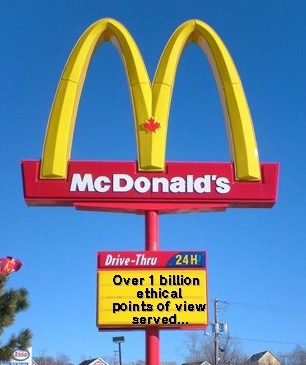
This is a new blog about ethical issues that arise in growing, shipping, processing, selling, regulating, and eating food. Food is a hot issue these days — that is, people are talking (and writing) a lot about what kinds of foods we should be producing and eating. But as far as I can tell, there aren’t many blogs dedicated specifically to sorting through the full range of ethical issues (or normative issues more generally) in a non-partisan way. This blog aims to help fill that gap.

I do not foresee long analytical blog entries. Rather, I expect to post excerpts from recent news stories, along with very brief comments and an invitation for others to comment.

Among the sorts of topics I envision tackling in this blog:

  • Is organic agriculture better, ethically, than ‘industrial’ agriculture?
  • Should genetically modified foods be labelled?
  • Is eating local better, ethically?
  • Just how far should companies be expected to go in ensuring their food products are safe?
  • Should fast-food companies and cola companies be held responsible for the obesity epidemic?
  • Is reducing the ‘carbon footprint’ of food something best left to the market?
  • Should health-related marketing claims about food nutrition be treated like claims about pharmaceuticals?
  • Should the growing of certain kinds of crops be subject to government subsidies?
  • Are there convincing reasons for or against human use of animals for food?
  • Do we worry too much about food, or not enough?

By way of self-introduction, I’ll start by saying that I’m a philosopher (that’s what my Ph.D. is in, and that’s what I teach). But you’ll find that this blog strays into economics, public policy, and environmental science, as the need arises and as my expertise permits. I’ve published a bit on food ethics (in particular, about the labelling of GM foods.) I also recently taught an course on food ethics (which used James McWilliams’ book Just Food as its main textbook (along with a bunch of scholarly articles). I write two other blogs: The Business Ethics Blog (my main blog), and the Biotech Ethics Blog. I also love to cook and to eat, and I love good wine and good single-malt scotch.

Posted in animal welfare, ecosystems, genetic modification, local, organic, regulation, safety, subsidies | Comments Off on Welcome to my new ‘Food Ethics’ blog