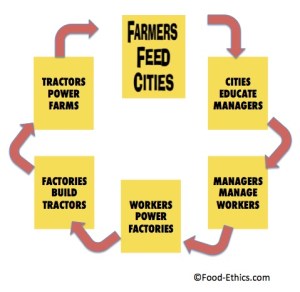
If you ate today, thank a farmer…and…?

Surely you’ve seen this bumper sticker: “If you ate today, thank a farmer.”

That’s fine advice — farmers (of various kinds) play a key role in food production. But it’s also pretty narrow advice.

It would be more accurate to say, “If you ate today, thank a farmer…”

AND…thank a truck driver (for getting the food from place to place)…
AND…thank whoever loaded the boxes onto the truck, and then off again…
AND…thank an engineer for designing the farmer’s tractor…
AND…thank the miner who mined the iron ore that became parts for the farmer’s tractor…
AND…thank an accountant for doing the books at the various companies…
AND…thank the oil company that powered the farmer’s tractor…
AND…thank the grocery store clerk who helped you at the checkout…
AND….?
———
And see also: Who Feeds Farmers?
farmers_feed_cities

Posted in agriculture, ethics, farmers | 4 Comments

Things that Matter: Drug Residue in Chinese Pork

You could tell a lot about your average foodie or food-safety advocate by asking them to list food-related issues by level of importance. Some people tend to focus on the latest feel-good trend (e.g., at least some versions of localism) and unsupported conjecture (e.g., many versions of the anti-GMO stance). Others focus on, you know, things that really can hurt us and that really require someone identifiable to take action.

Here’s one that really is important:
China pig crisis: Drug residues in pork, By Maryn McKenna, writing for Wired.

In China, more than 2,000 tons of fresh pork and pork products — at a minimum, 4 million pounds — have been recalled because the meat has tested positive for clenbuterol, a stimulant that is illegal in food-producing animals not only in China but in Europe and the United States. Another 1.6 million pigs are being tested….

This one is important not just because of the 4 million pounds of recalled pork, but because of the likelihood of such practices being widespread and undetected, and the likelihood that they could continue into the future. Of course, by calling this an important issue, I’m admittedly revealing my own bias here, in favour of issues that a) are directly related to human health, b) are matters of voluntary human behaviour, and c) matters where some combination of ethics and regulation might have a chance of making things better.

Posted in activism, agriculture, animal welfare, ethics, factory farms, health, international, meat, safety | 4 Comments

Breast Milk Ice Cream?

From the BBC: Breast milk ice cream goes on sale in Covent Garden

A restaurant in London’s Covent Garden is serving a new range of ice cream, made with breast milk.

The dessert, called Baby Gaga, is churned with donations from London mother Victoria Hiley, and served with a rusk and an optional shot of Calpol or Bonjela…
….
“Some people will hear about it and go yuck – but actually it’s pure organic, free-range and totally natural.”

And, we could add, its production should please animal welfare and animal rights advocates, since it involves no indentured servitude on the part of animals.

My question, here, is roughly the same as my question about synthetic meat: beyond the “yuck” factor, is there any actual ethical objection to eating ice cream made with human milk?

Posted in animal rights, animal welfare, ethics, milk, natural | 1 Comment

Monsanto Wins on Sugar Beets

By Karen Gullo, for Bloomberg: Monsanto Wins Reversal of Order to Destroy Sugar Beet Plants

Monsanto Co. and the U.S. Agriculture Department won reversal of a judge’s order to destroy genetically modified sugar beet seedlings planted last year, a federal appeals court in San Francisco ruled today.

A three-judge panel, ruling in a lawsuit filed by environmental and organic seed groups over sugar beet plants modified to withstand Monsanto’s Roundup herbicide, said the groups hadn’t shown that the seedlings were likely to contaminate natural sugar beet plants….

How much longer can such issues be left up to courts? Or, perhaps more to the point, what would have to happen in order to get either side of the GM debate to stop using that mechanism?

Posted in agriculture, biotechnology, ecosystems, ethics, genetic modification, GMO, law, USDA | Comments Off on Monsanto Wins on Sugar Beets

Nudging College Kids to Eat Less

How do you get college freshman to avoid that first-term weight-gain known as “the Freshman 25?” What’s the right cafeteria policy? How do you balance making sure every student gets enough to meet his or her needs, without overfeeding them? How do you balance their right to choose against their natural human tendency to overeat in the face of plenty?

For one suggestion, see this story by Jenna Johnson, for the Washington Post: Cafeteria trays vanishing from colleges in effort to save food

[At Virginia Tech], Students loaded their trays with Belgian waffles, brick-oven-baked pizza, falafel, Brazilian skewered meat, pad Thai, fruit juice concoctions and elaborate desserts – so much food that even the biggest of guys with the biggest of appetites could not always clean their plates.

As food service workers watched thousands of pounds of food go to waste, the university decided to make a move increasingly common at higher-education institutions nationwide: It got rid of cafeteria trays….

This is a classic example of what Richard Thaler and Cass Sunstein refer to as a nudge, in their book by that name. Students aren’t being forced to eat less. Their freedom of choice isn’t being taken away. They’re just being nudged.

Posted in choice, diets, health, public policy, teens | 1 Comment

Caution on “Green” Claims for Organics

A major UK farmers’ organization is cautioning those of its members who grow organic foods against leaning too heavily on claims that such foods are more environmentally-friendly than non-organics.

Here’s the story, by Caroline Stocks, for Farmers Weekly Interactive: Organic farmers told to rein in green claims

Organic farmers should avoid making claims about the environmental benefits of organic agriculture in a bid to increase demand for their produce, NFU president Peter Kendall has said.

Speaking at the Soil Association conference in Manchester on Wednesday (9 February), Mr Kendall said organic producers needed to convince consumers about the quality of their produce rather than making claims which might not stand up.

The NFU (National Farmers Union) includes both non-organic and organic farmers. Or, as their website’s page about organics puts it, the organization “represents around 2,000 farmers with an interest in the organic sector” (in addition to farmers engaged in other kinds of farming).

Notice the tension here: the NFU represents the interests of all kinds of farmers (at least to the extent to which its membership is diverse). But it also faces a challenge in terms of competition between its members, and in particular competition between categories of members. In his speech, Mr. Kendall is basically suggesting that certain kinds of ethical arguments ought to be played down, in order to promote the interests of farmers (and, in fairness, of consumers) as a group.

Posted in agriculture, environment, farmers, organic | 1 Comment

Ethical Ranking for Tuna

Tuna. It’s the type of fish most likely to be in the average pantry at any given moment. And it is perhaps the one fish that has most clearly been turned into something very like a true commodity. On your supermarket shelf, it amounts to row upon row of pretty much anonymous fish packed into standardized cans. Aside from variations like whether it’s packed in oil or vegetable broth, and whether the meat is “whole” or “chunk” or “flaked,” it’s basically all the same to most consumers. When I was a kid, we didn’t even know such differences existed. Tuna is tuna, right? Of course, that’s a perception that various companies that package tuna would like to eliminate. They want you to believe that StarKist really is different from Clover Leaf, and that their brand of tuna is best. The notion that “all tuna is the same” is also, as it happens, a perception the people at Greenpeace are trying to combat, but for very different reasons.

Here’s the story, by Monique Beaudin, in the Vancouver Sun: Greenpeace asks shoppers to fish around for ethical tuna

A new report by Greenpeace Canada might make you reconsider eating a tuna sandwich.

The environmental group says most canned tuna in Canada is fished from at-risk species using “destructive” fishing methods.

Greenpeace, which has been lobbying Canadian retailers to adopt sustainable seafood policies, looked at how and where canned tuna sold by 14 companies across the country is caught.

Only Wild Planet Foods and Raincoast Trading got a passing grade from Greenpeace because they clearly explain what kinds of tuna they use — albacore and skipjack — and where and how their fish were caught — in both cases, without longlines.

Clover Leaf, the company with the largest market share of canned tuna in Canada, failed because it didn’t answer any of the environmental group’s questions. King said she didn’t know why Clover Leaf didn’t respond, and the company could not be reached for comment Tuesday….

Here’s the direct link to Greenpeace Canada’s Tuna Sustainability Ranking.

Posted in activism, aquaculture, ecosystems, endangered species, ethics, fisheries, sustainability | 1 Comment

Would You Like Your Synthetic Meat GM or Non-GM?

This news story is not exactly news. We already know that synthetic meat is under development in various labs around the world. But it does raise a fresh issue or two.

By Harriet McLeo, for Reuters: South Carolina scientist works to grow meat in lab

In a small laboratory on an upper floor of the basic science building at the Medical University of South Carolina, Vladimir Mironov, M.D., Ph.D., has been working for a decade to grow meat.

A developmental biologist and tissue engineer, Dr. Mironov, 56, is one of only a few scientists worldwide involved in bioengineering “cultured” meat.

It’s a product he believes could help solve future global food crises resulting from shrinking amounts of land available for growing meat the old-fashioned way … on the hoof.

Growth of “in-vitro” or cultured meat is also under way in the Netherlands, Mironov told Reuters in an interview, but in the United States, it is science in search of funding and demand.

Interestingly, the scientist at the centre of this story raises the question of genetic modification. Genetic modification isn’t a necessary part of making synthetic meat, but it might be useful in tailoring the meat in various ways:

“It will be functional, natural, designed food,” Mironov said. “How do you want it to taste? You want a little bit of fat, you want pork, you want lamb? We design exactly what you want. We can design texture.

“I believe we can do it without genes. But there is no evidence that if you add genes the quality of food will somehow suffer. Genetically modified food is already normal practice and nobody dies.”

So, are there people out there who would be in favour of synthetic meat but against genetically-modified synthetic meat?

Posted in animal welfare, biotechnology, ethics, genes, GMO, industrial, meat, natural, science, synthetic meat, values | 9 Comments

When Vegetarianism Was Patriotic

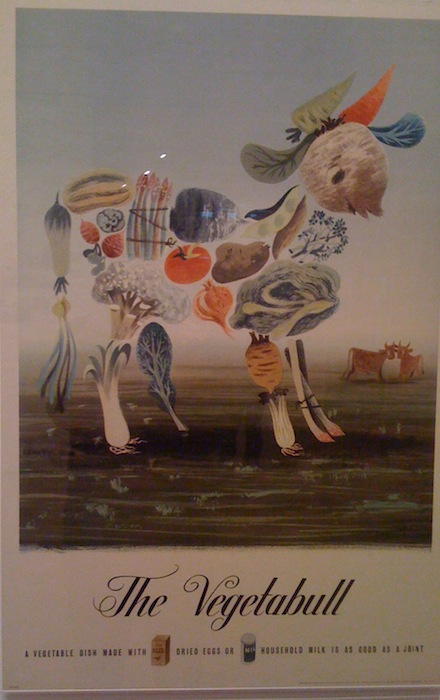
I snapped this picture at MOMA over the weekend:

It’s a World War II propaganda poster for the British War Office / Ministry of Food.

The caption says, “A vegetable dish made with dried eggs or household milk is as good as a joint.”

Posted in ethics, public policy, values, vegetarianism | Comments Off on When Vegetarianism Was Patriotic

Using, Regulating and Testing for Antibiotics in Milk

Here’s an interesting story about efforts to regulate competitive behaviour in the food industry:

By William Neuman, for the NYT: F.D.A and Dairy Industry Spar Over Testing of Milk

Each year, federal inspectors find illegal levels of antibiotics in hundreds of older dairy cows bound for the slaughterhouse. Concerned that those antibiotics might also be contaminating the milk Americans drink, the Food and Drug Administration intended to begin tests this month on the milk from farms that had repeatedly sold cows tainted by drug residue….

The concern here is primarily about the (uncertain) health effects that such drug residue might have on those who consume milk. (And with the effect that over-use of antibiotics on farms can have for the long-term effectiveness of their use in humans.) From the point of view of the milk consumer, such drugs are an unnecessary artificial additive. But there’s nothing artificial about the competitive pressures that dairy farmers are under. That is the most natural thing in the world. And (a separate point) there’s nothing wrong with competition, either. Generally, when farmers compete — by producing better products, or by finding new efficiencies that allow them to lower prices — consumers win. So consumers should want farmers to engage in tough competition, but within limits. Those limits presumably include not just things like judicious use of antibiotics, but also working (within reason) with the regulatory agencies (like the FDA) tasked with acting as an external check on their competition.

But back to the issue of the long-term effectiveness of antibiotics in humans. According to the NYT story,

But food safety advocates said that the F.D.A.’s preliminary findings raised issues about the possible overuse of antibiotics in livestock, which many fear could undermine the effectiveness of drugs to combat human illnesses….

It’s worth noting that the worry here isn’t about effects on those who consume milk, but rather about effects on the entire population. That means what we’ve see here is a competitive domain (the dairy industry) that benefits one group (consumers of milk) but that also has effects on society as a whole.

(p.s. for more insight into the ethical implications of structured, limited competition, see the new blog Ethics For Adversaries.)

Posted in agriculture, factory farms, health, milk, regulation, safety | 2 Comments