
Peter Singer in Vegetarianism Debate

I’m not sure which factor does more to make this a lopsided debate: the fact that it was an audience of university students, the fact that it was a self-selected audience that probably showed up already sympathetic to one side, or the fact that one side featured the world’s most prominent proponent of vegetarianism.

Here’s the story, from the Daily Princetonian: Singer wins vegetarian debate, 75-35

Bruce Friedrich, vice president for policy and government affairs for People for the Ethical Treatment of Animals, and bioethics professor Peter Singer presented the affirmative case on the resolution, “This house believes that eating meat is unethical,” at a debate sponsored by the American Whig-Cliosophic Society….

(For those of you who haven’t heard of him, I provide a brief explanation of who Peter Singer is.)

Posted in animal rights, animal welfare, ethics, health, meat, nutrition, vegan, vegetarianism | Comments Off on Peter Singer in Vegetarianism Debate

The Right to Know What I’m Eating

Magna CartaIn the debate over the labelling (or non-labelling) of genetically-modified foods, one of the most common refrains is that consumers “have a right to know” what they’re eating. I’ve commented briefly on that here before. (See “Should Companies Label Genetically Modified Foods?”) But it’s an important and complicated topic, so I’m going to say a little more here.

We first need to distinguish legal from moral rights. Legal rights are established through legislation or through precedents set by courts. But when people say they have a “right to know” what they’re eating, they’re not usually referring to a legal right (especially given that, as far as genetic modification goes, there just is no such legal right in the U.S. or Canada). No, when people say they have a right to know what they’re eating, they’re talking about a moral right to that information — they mean that it is ethically obligatory for someone to provide it to them. But simply claiming a right doesn’t cause that right to spring into being. It needs to be justified some way, grounded in some strong ethical argument.

So, when does someone have a moral “right” to some piece of information? The philosophical literature on rights is enormous. I’ll just offer here what I think is a fairly straightforward explanation of the ethical grounding of rights, without going into too much philosophical detail.

Rights are mechanisms for protecting important human interests. In free societies, for example, we have a right to security of person and a right to own property and a right to free speech, because we see these things as crucially important to living a good human life. We may have other interests or needs, but not all of them are protected by rights. Why? Well, it’s worth remembering that when someone has a right to something, this imposes obligations on other people. In some cases (as in the right to free speech) it means an obligation not to interfere. In other cases it means an obligation actually to provide something (for example, if I’ve performed my job as promised, I have a right to be paid and my employer has a positive obligation to provide me with my wages). It’s also important to note that, given that rights impose obligations on other people, we need at least to consider just how burdensome those obligations are, before we assert the correlative right with any certainty. (For example: even if you desperately need a kidney, you don’t have a right to mine while I’m still using it.)

Now, let’s consider information. Given what we’ve said above, we can say (at least roughly) that an individual has a right to a piece of information when having that information is necessary for promoting or protecting his or her most important interests. Some of my favourite examples:

  • In a democracy, we have a very strong moral right to know who the candidates for political office are. If we don’t have that information, it’s impossible to exercise our rights (and duties) as citizens. The intellectual tradition supporting this right goes back through over 2,000 years of democratic theory.
  • We also have a strong right to know our medical diagnoses. Gone is the day when “doctor knows best” was the rule. Today, we consider it essential to let patients play a leading role in decision-making about their own care, and information about diagnosis is crucial for that. In only the rarest of exceptional cases is it considered ethically permissible to withhold that information from a patient.
  • When arrested by the police, you have a very strong right — legally, but also morally — to know what you’ve been charged with. The police are agents of the state, and it is pretty clearly impossible to defend oneself against the awesome power of the state without knowing the charges laid against you. The right to that piece of information, then, is rooted in important limits on the power of the state, going back at least to the Magna Carta.

What about the right to know what we are eating?

To illustrate, let’s consider a trio of imaginary (but not implausible) cases where an individual might want to know something about what they’re eating, and consider whether in addition to wanting the information, that person has a right to it.

First, imagine you’re eating chicken gumbo in a New Orleans restaurant. Suddenly, you feel a tightening in your throat. You start to panic — you’re allergic to shrimp, and though no shrimp was listed among the ingredients when you read the menu, you worry that there might well be some in there. You summon the waiter and ask if there’s any shrimp in the gumbo. The waiter hesitates: “The gumbo recipe is the Chef’s most closely-guarded secret. I’m not allowed to tell you that!” Do you have a right to this information? Of course you do. Having this information is utterly central to your wellbeing: this is literally a matter of life and death. You don’t just want it. You don’t just have an interest in it. You have a right to it.

Next, imagine you’re a waiter or waitress at a restaurant. As you set a plate of cheese tortellini in front of a customer who says to you: “I’m a vegetarian. So I need to know, was the cheese in this tortellini made with rennet from a calf’s stomach, or is it from a vegetable source?” You reply, “I’m sorry, but I have no idea. I don’t have that information, and I don’t know how to get it.” Stunned, the customer replies, “But I have a right to know what I’m eating!” Does she? Probably not. Vegetarianism is pretty respectable these days, and is often rooted in very deeply-held concerns about health or animal welfare. But it may be nearly impossible, and certainly burdensome, for the restaurant to provide the information.

Finally, imagine again that you’re a waiter or waitress. As you set a plate of food down in front of a customer, the customer asks: “Were any ‘minorities’ involved in the production of this food? Do you have any foreigners working in the kitchen?” Appalled, you stammer: “Excuse me?!” The customer continues, “I don’t like immigrants, and I don’t like the idea of them touching my food. I have the right to know what I’m eating!” Does this customer have the right to that information? Most of us, I think, would say no, of course not. She might see that information as really important — important to letting her live her life the way she wants to — but few of us would agree that anyone else is obligated to help her live out her racist values.

I think examples like these help make clear that no one really thinks that we have a right to know everything we might want to know about the food we eat. When it comes to debates over the right to a specific piece of information about what we’re eating, we need to think seriously about whether a) that bit of information is central to protecting an individual’s interests, b) whether those interests are ones that we can agree, socially, are in need of protecting, and c) whether recognizing such a right would impose undue burdens on others.


Note: coincidentally, today happens to be “International Right to Know Day,” though its goal is to raise awareness of the right of citizens to information held by governments, not by food producers.


Addendum:
This has been such a popular (and controversial) blog entry that I wanted to add 3 notes:
1) A few people found the racism example above inflammatory. Sorry about that. The intention was merely to illustrate that there are some bits of information about our food that almost no one thinks we have a right to.
2) Over on my Business Ethics Blog, I did a related piece on the Consumers’ Right to Information.
3) I will soon be posting something here on the Food Ethics Blog about voluntary labelling and the producer’s right to tell.
—–
Further Addendum:
I wrote a scholarly article on this topic, which you can find here: Corporate Decisions about Labelling Genetically Modified Foods


Posted in consumerism, GMO, labeling, restaurants, safety, values, vegetarianism | 35 Comments

Pom: Juice, Drug, or Something New?

The makers of PomWonderful are under fire for their advertising claims. PomWonderful is a juice…a food product.

But its makers claim that it can have specific health effects. Welcome to the complicated world of functional foods.

Here’s the story, by Edward Wyatt, for the NYT: Claims by Pom Juice Called Deceptive

PomWonderful, the pricey and popular pomegranate juice sold in the distinctly curvaceous bottle, is advertised as helping reduce the risk of heart disease, prostate cancer and impotence. But according to the Federal Trade Commission, the evidence does not back up those claims….

Here’s the interesting bit:

Pom also said that the F.T.C. was, in seeking to require F.D.A. oversight over the company’s claims, treating pomegranate juice as a drug, although the products “do not carry the risks associated with pharmaceutical drugs….”

Well, once upon a time the distinction between food & drug may have been clear. But not in 2010. As I blogged recently, Nestlé has just announced the launch of a new business unit aimed at developing high-tech foods. And if foods can’t carry the risks associated with pharmaceuticals, then why are so many people up in arms about the FDA’s apparent readiness to approve GM salmon?

Posted in Uncategorized | 4 Comments

Salmonella in Eggs, Rabies in Dogs

It’s good to have the occasional reminder that food safety is an issue everywhere.

See this item, by By Donald G. McNeil Jr. for NYT Health: Vitenam: With Rabies Deaths on the Rise, a Menu Item Gets a Closer Look.

Summarizing very briefly: Dogs can carry rabies. Few dogs in Vietnam are vaccinated against it. Lots of dogs are eaten in Vietnam, and it is apparently possible for the virus to spread from dogs to humans that way.

Education is clearly a factor here (eating a sick animal is not a good idea, and rabies produces visible signs). Technology is also a factor (Vietnamese have limited access to modern anti-rabies vaccine). As far as I can tell from this story, factory farming, however, is not part of the problem.

Posted in health, international, meat, safety, science | Comments Off on Salmonella in Eggs, Rabies in Dogs

Health Foods, Junk Foods — All Processed

Nestlé (the food manufacturing giant based in Switzerland) has just announced its plan to expand into the realm of health food.

According to the NYT:

Nestlé announced the creation of Nestlé Health Science as well as a research body, the Nestlé Institute of Health Sciences, “to pioneer a new industry between food and pharma.”

It said the two bodies would develop nutritional products to help prevent and treat conditions like diabetes, obesity, cardiovascular disease and Alzheimer’s disease, which are increasingly placing a burden on Western health care systems….

So, is there anything surprising, any contradiction in the idea of the makers of Aero bars also producing health food? Well, to start with, Nestlé is already a maker of baby foods, a category in which nutrition is considered paramount. But more generally, the move makes sense because, after all, health foods (as opposed to “healthy foods”) are just another category of processed foods. Given how hard it’s turning out to get people to eat their veggies, it’s not that hard to imagine a future in which the world is dominated by two kinds of processed food: processed junk food, and processed health food.

Now, I’m not entirely cynical about the kinds of high-tech nutritional products Nestlé is talking about; it may well be that science is going to do great things in the area of functional foods. But if you’re interested in understanding the food industry, it seems to me that it’s essential to understand the reasons companies are attracted to food processing — with all its potential for efficiency, innovation, and customization — as opposed to simply growing and shipping stuff like carrots and broccoli.

Posted in health claims, industrial, junk food, nutrition, science | 3 Comments

Eat Your Veggies!

I love vegetables. In fact, I never met a vegetable I didn’t like (except ones that are poorly prepared), and veggies make up most of my diet. Alas, the same cannot be said for everyone.

See this story, by Kim Severson, for the NY Times: Told to Eat Its Vegetables, America Orders Fries

[Various] efforts, high and low, are aimed at the same thing: getting America to eat its vegetables.

Good luck. Despite two decades of public health initiatives, stricter government dietary guidelines, record growth of farmers’ markets and the ease of products like salad in a bag, Americans still aren’t eating enough vegetables.

This month, the Centers for Disease Control and Prevention issued a comprehensive nationwide behavioral study of fruit and vegetable consumption. Only 26 percent of the nation’s adults eat vegetables three or more times a day, it concluded. (And no, that does not include French fries.)

A few quick comments, from an ethics point of view:

1) Interestingly, the word “parents” appears precisely zero times in the NYT story. I’m not generally an adherent of the ‘blame-the-parents for everything’ school of thought, but clearly there’s an element of parental responsibility, here. If kids grow up not eating vegetables, it has to have something to do with what their parents buy, prepare, and put in front of them.

2) Second, we should remember one of the primary principles of economics: people respond to incentives, and money is a key incentive. If you want people to eat vegetables, their price — relative to other options — needs to go down. Since it’s unreasonable to expect farmers voluntarily to cut prices, the need to make vegetables cheaper very likely means a shift in agricultural policy, and that’s a pretty tough sell, politically.

3) Finally, we ought to acknowledge that getting people to eat more veggies may simply be an un-winnable battle against the evolutionary settings of the human taste-buds. That’s not at all to say that habits can’t change. Clearly lots of people (like me) do have tastes that lend themselves to heavy consumption of vegetable. But people like junk food, and they may well be willing to pay the costs of eating them. They like things that are salty and fatty and deep-fried. Salty, fatty, deep-fried veggies fit the bill, of course, but more of those is not exactly what nutritionists are after. Anyone suggesting changes in public policy to encourage people to eat more veggies have to recognize that they’re acting paternalistically; the extent to which such paternalism is justified is a hard question.

Posted in consumerism, ethics, health, junk food, kids, marketing, subsidies, taste | 1 Comment

KFC Uses Women’s Buns as Ad Space

Advertising is often contentious. Food advertising is perhaps doubly so. Add to that accusations of objectification and commodification of women’s bodies, and you’ve got yourself a marketing ethics case-study.
Here’s the story, by Bruce Horowitz, for USA Today: KFC pays college women for ad space on buns

KFC wants folks to watch its backside.

Or, more precisely, the backsides of female college students it’s recruiting to promote its hot new bunless Double Down sandwiches.

Women on college campuses are being paid $500 each to hand out coupons while wearing fitted sweatpants with “Double Down” in large letters across their rear ends.

The nation’s largest women’s group doesn’t like it one bit. “It’s so obnoxious to once again be using women’s bodies to sell fundamentally unhealthy products,” says Terry O’Neill, president of the National Organization for Women….

As I noted above, there are several different things that might be objected to, in regards to KFC’s latest marketing scheme. Then again, there’s nothing really unique here…and as far as marketing schemes that make use of women’s bodies, this one is pretty tame. Of course, that might just be the problem: using women’s bodies this way has come to be expected, and has even become kind of passé (which is not to say it’s not effective).

But in terms of food ethics, I’m intrigued by the second part of Terry O’Neill’s complaint: namely that this controversial marketing technique is being used to sell unhealthy food. Does that really make a difference, here? Certainly, if there are 2 different kinds of ethical complaints, that’s worth knowing. But O’Neill seems to be implying that there’s more than just a doubling of wrongs, here. She seems to imply that using women’s bodies to sell junk food (mostly to men) is somehow especially wrong.

What do you think?

Posted in advertising, ethics, fast food, health, junk food, marketing | 1 Comment

Old Navy’s “Formula Powered” Onesie

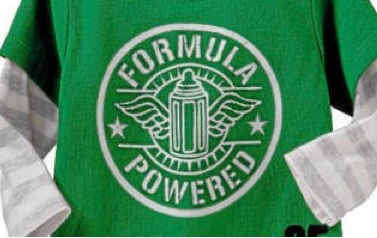
I never thought I’d be writing a blog entry about a “onesie.” Onesies aren’t normally the subject of ethical debate or controversy. But then, it’s not often that the logo on a piece of clothing for infants raises the ire of breastfeeding advocates and raises the spectre of corporate collusion.
See: Mommy bloggers tear strip off Old Navy’s ‘Formula Powered’ outfit, by Tralee Pearce (Globe & Mail)

Mommy bloggers are up in arms over a baby outfit’s cheeky logo that has led retailer Old Navy to apologize to offended customers.

At issue? An air-force-style insignia on a dark green boy’s onesie reading “Formula Powered.” The outfit has enraged breastfeeding advocates across North America.

A number of mom bloggers have linked to the $5 (U.S.) item on Old Navy’s website while calling for a boycott of the chain, casting the item as a propaganda tool of the formula industry….

Note that there are two different complaints, here.

One is that Old Navy is, through this product, promoting use of formula, despite the evidence that in most cases breastfeeding is the superior alternative.

The other accusation — not attributed to anyone in particular — is interesting. And that’s the accusation that promotion of formula is not just the effect of the Old Navy onesie, but the intent. The claim that the onesie is a “propaganda tool of the formula industry” implies that this was an intentional move, perhaps one paid for by the makers of infant formula. As far as the G&M story indicates, that accusation is unsubstantiated. If this really is a marketing move on the part of the formula industry, that certainly would be interesting (and perhaps alarming). Does anyone know of any evidence one way or the other?

Posted in Uncategorized | 1 Comment

Explanations and Excuses for Salmonella-Infected Eggs

So, we finally get to hear the salmonella-in-our-eggs story from the man behind the mess.

See this breaking story, by Gardiner Harris, writing for the NYT: Egg Producer Says His Business Grew Too Quickly

An Iowa egg producer at the center of a nationwide outbreak of salmonella apologized to a Congressional panel on Wednesday and admitted that his family operation “got big quite a while before we stopped acting like we were small.”

“What I mean by that is we were big before we started adopting sophisticated procedures to be sure we met all of the government requirements,” the egg producer, Austin J. DeCoster, said in testimony before a House Energy and Commerce subcommittee….

Two quick points.

First, DeCoster’s testimony lines up pretty well with my own analysis from a few weeks back. (See: When is a Factory Farm Not a Factory Farm?) Basically, Wright County Egg was a big operation behaving like a small one. It needed to be run professionally; but instead it was run as if producing millions of eggs a year were an endeavour for amateurs. But while I offered the above hypothesis as an explanation, DeCoster seems to be offering it as an excuse, and the two are very different.

Second, note that DeCoster’s focus — even as he apologizes and asks for forgiveness — is on whether his company met government requirements. There’s no focus on, say, excellence or even just on doing things right. Anyone in business ought to know that government regulations can only ever establish minimal performance standards — the kinds of standards that, if followed, would hopefully prevent you from killing your customers.

Posted in Uncategorized | 2 Comments

How Good (or Bad) is the FDA?

The U.S. Food and Drug Administration is the target of plenty of criticism. In fact, almost nobody seems to like the FDA — except maybe occasionally when they institute a recall or impose a penalty, and even then there’s almost always someone who complains that the FDA did too little, too late.

Now, I have no particular view of the FDA. I have (like everyone, probably) heard of FDA policies and decisions with which I’ve disagreed. But that doesn’t tell you much. And I’ve also read about what seem to be recurring deficiencies in their systems & programs. I’ve heard about political and corporate interference. I’ve heard complaints that the FDA just doesn’t have the teeth to do its job effectively. On the other hand, I’ve also heard arguments that the FDA is too powerful, that it interferes with the market too much (too much red tape, slowing innovation, etc.), and that, if there were no FDA, the courts would be perfectly able to deal effectively with drug companies and food producers who behave badly.

So: what is the average American citizen (or the average small business) to make of this? Of course, as a Canadian I could just as easily ask what Canadians should think of Health Canada (which is the Canadian federal agency in charge of roughly the same stuff that the FDA is in charge of in the U.S.). Pot shots aside, how good (or bad) are our federal food-and-drug agencies?

Now, the simple answer to the question in the title of this blog entry is simply this: “not good enough.” And in a sense, that is of course true. No regulatory agency is perfect. Many are far from perfect. From a food activist’s point of view, the FDA just isn’t as good as it could be at protecting our health. (And from a free-market economist’s point of view, maybe the FDA just isn’t good enough to make up for the way it impedes innovation, etc.) But that answer isn’t very illuminating. What we want is not a comparison to some imaginary ideal, but a comparison to practical possibilities.

So here’s a question I’m hoping someone has the answer to: how good (or bad) is the FDA (or your nation’s parallel agency) on a comparative international basis. Is there any way of answering that question? Has anybody tried? (And note that arguments of the form, “The FDA sucks because it did such-and-such” are pretty weak. What we’re looking for here is indications of overall performance.)

Now, here’s a suggestion of why international comparisons are useful. Most of us are pretty wrapped up in what we see as the inadequacies of our own governments and government agencies. Looking abroad can be illuminating. Lots of Americans, for example, probably think there’s a lot of corruption in the U.S. But a quick look at Transparency International’s Corruption Perceptions Index shows that the U.S. ranks 19th out of 180 countries. Not exactly gold-metal performance, but it means that the U.S. has a level of corruption that countries like Uzbekistan and Burundi and Yemen could only dream of.

So, to ask my question in a different way, what countries (if any) have food-and-drug protection agencies that Americans should wish they had?

Posted in FDA, health, public policy, regulation, safety | 3 Comments