Energy Drinks Again — This Time, With Alcohol

I recently blogged about controversy over energy drinks, and particularly over marketing them to young people.

Well, energy drinks are back in the news. And this time, they’ve got added booze.
See: Caffeine and Alcohol Drink Is Potent Mix for Young, (by Abby Goodnough, for the NYT).

Mixing alcohol and caffeine is hardly a new concept, but a rash of cases involving students and others who landed at hospitals after drinking beverages that combine the two in a single large can has alarmed college and health officials around the country.

The drinks are dangerous, doctors say, because the caffeine masks the effects of the alcohol, keeping consumers from realizing just how intoxicated they are.

OK, so caffeine isn’t new. And booze isn’t new. Drinking them together isn’t all that new: lots of people enjoy rum-and-cola, and I have a friend who likes to alternate whisky and espresso. So should these new energy/alcohol drinks be considered especially dangerous?

The proof of the pudding, as they say, is in the tasting:

“This is one of the most dangerous new alcohol concoctions I have ever seen,” said Dr. Michael Reihart, an emergency room doctor at Lancaster General Hospital in Lancaster, Pa., who said he had treated more than a dozen teenagers and adults over the last three months who had been brought there after drinking Four Loko.

Posted in ethics, FDA, health, kids, marketing, teens | Comments Off on Energy Drinks Again — This Time, With Alcohol

Prince Charles on Impending Agricultural Doom

Prince Charles — heir to the throne of England — has made a hobby of expressing opinions on everything from architecture to nanotechnology. For the most part, he lacks the requisite expertise to expound upon these topics, and so he often ends up saying goofy things that are promptly refuted by people who do have the relevant expertise. But that doesn’t seem to slow him down. One of his favourite themes is the evils of science and technology, and the necessity of living in “harmony” with nature, whatever that means.

Here he goes again:

Industrial farming puts ecosystems at risk of collapse, warns Prince Charles

Prince Charles has warned that the world’s ecosystems face collapse because of a dangerous over-reliance on industrial farming systems that work against nature rather than with it.

In a speech to launch a new sustainable farming project with the supermarket chain Morrisons, the Prince of Wales said farming needed to shift quickly to low-impact, organic and low-carbon methods to survive into the long term. The prince directly attacked farms that “treat animals like machines by using industrial rearing systems”….

“Collapse?” Seriously…collapse? I think there’s plenty of good reason to think that it would be good to find ways to use less fertilizer, less pesticide, and to reduce fossil-fuel inputs to agriculture generally. And if we’re going to keep raising animals for food, it would be a good thing to find more humane ways of doing so. But ecosystem collapse? Please.

Now, I’m sure Morrisons is glad to have such a high-profile advocate. But it’s worth noting that Charles’ views differ markedly from those of executives at Morrisons. His Royal Highness is a staunch defender of organic agriculture. According to him,

Sustainable farming does not rely upon artificial fertilisers and growth promoters, nor the prophilactic use of antibiotics….

And Morrisons?

Dalton Philips, the chief executive of Morrisons, said before the prince spoke that solely organic farming was not realistic, as it cost up to 40% more and was largely unaffordable for most consumers.

Posted in activism, advertising, factory farms | Comments Off on Prince Charles on Impending Agricultural Doom

“Yes Please” and “No Thanks” to Animal Welfare Labels

Some people want to know more about how their food is produced.

On the other hand, some people really really don’t want to know more about how their food is produced.

By William Neuman, writing for the NYT: New Way to Help Chickens Cross to Other Side

Shoppers in the supermarket today can buy chicken free of nearly everything but adjectives. It comes free-range, cage-free, antibiotic-free, raised on vegetarian feed, organic, even air-chilled.

Coming soon: stress-free?

Two premium chicken producers, Bell & Evans in Pennsylvania and Mary’s Chickens in California, are preparing to switch to a system of killing their birds that they consider more humane. The new system uses carbon dioxide gas to gently render the birds unconscious before they are hung by their feet to have their throats slit, sparing them the potential suffering associated with conventional slaughter methods.

This seems like a positive trend. You don’t have to be a vegan or a radical animal rights advocate to think that methods of slaughter that reduce suffering are a good thing. But, as the NYT story points out, the change brings a bit of a marketing dilemma. To label, or not to label?

Generally, companies that do something good want to brag about it. But sometimes even bragging about something genuinely good requires raising a topic people would rather not think about:

“Most of the time, people don’t want to think about how the animal was killed,” said David Pitman, whose family owns Mary’s Chickens.

As far as I can think, that bit of disagreement makes this particular labelling issue unique. There are obviously other cases in which some people want a particular bit of labelling, and others don’t. But most often, those who don’t are pretty passive about it. “Not wanting” labelling (of, e.g., GM foods) typically means “not caring.” But in the chicken-stunning case, some people will really hate the idea of seeing labels — and that means any labels even mentioning the topic. In fact, even people who would, upon seeing the “Humanely Slaughtered”, be more likely to make a purchase, may not want to see those labels. Under those circumstances, what should producers do? If (as some people think) you have a right to know, does that right trump other considerations, including your desire not to?

Posted in agriculture, animal welfare, labeling, meat, values | 2 Comments

Water-Efficient Maize and Alternative Models for GM Seeds

Yesterday’s blog entry (“In Praise of Industrialized Food”) pointed out that we shouldn’t discount entirely the value and potential of mass-produced food simply because so much of the mass-produced food currently available leaves much to be desired, nutritionally.

Today’s is about why we shouldn’t take all that we dislike about Monsanto and assume that it applies equally to all genetically-modified crop projects.

Case in point: this story, from the news service IPS: Could Water-Efficient Maize Boost Africa’s Food Security?

A team of scientists in the United States, Mexico, Kenya, Uganda, Tanzania, South Africa and Mozambique has developed water-efficient maize varieties under the Water Efficient Maize for Africa (WEMA) project. The high-yielding maize varieties are said to be adapted to African conditions and tolerant to various stresses, including pest and disease resistance, found on farmers’ fields in Eastern and Southern Africa.

Soon controlled field trials of 12 WEMA varieties will begin in the five African countries.

This is essentially an example of a non-profit (or partially non-profit) approach to GM crop development:

…smallholder farmers will have to pay for the seeds because Monsanto was donating advanced breeding, biotechnology, and expertise to improve the drought tolerance of maize varieties adapted to African conditions. However, they will not be charged royalties.

Skeptics, of course, remain…well, skeptical. Bob Phelps, of Gene Ethics in Australia….

is not convinced. He said nothing is free in the long run and African farmers will pay year after year for GM seed that they cannot save for replanting.

“Monsanto offers its GM seed products free at first, as it did in South America with soy and corn,” he said.

Sounds like speculation to me. But the point here is that the coalition involved in this project is just one of many possible permutations. Frankly, the involvement of Monsanto in any project worries me, but it’s important to remember that Monsanto’s (historial) approach is not the only approach, and the profit-seeking model of GM seed development is not the only model possible.

Posted in agriculture, biotechnology, ethics, farmers, genetic modification, GMO, science | Comments Off on Water-Efficient Maize and Alternative Models for GM Seeds

In Praise of Industrialized Food

Check out this piece, by Rachel Laudan, in the Utne Reader: In Praise of Fast Food. (It’s worth noting right up front that the title of the piece is misleading. It’s not a defense of fast food, in the McDonalds and Pizza Hut sense. It’s more like a limited defence of modern, partially-industrialized food.)

Here’s a representative bit:

By the standard measures of health and nutrition—life expectancy and height—our ancestors were far worse off than we are. Much of the blame was due to diet, exacerbated by living conditions and infections that affect the body’s ability to use food. No amount of nostalgia for the pastoral foods of the distant past can wish away the fact that our ancestors lived mean, short lives, constantly afflicted with diseases, many of which can be directly attributed to what they did and did not eat.

Historical myths, though, can mislead as much by what they don’t say as by what they do say—and nostalgia for the past typically glosses over the moral problems intrinsic to the labor of producing food. Most men were born to a life of labor in the fields, most women to a life of grinding, chopping, and cooking….

Lauden’s point, basically, is that old-fashioned “natural” food isn’t uniformly marvellous, and modern mass-produced food isn’t all bad.

The comments section under Lauden’s article includes plenty of harsh criticisms. Most accuse her of some form of either straw man or false dichotomy. Maybe that’s fair. Maybe the so-called “culinary Luddites” she criticizes don’t exist. Maybe no one really thinks that all-and-only natural, artisan, organic, hand-made foods are good and nutritious and right. But if you take Lauden’s argument with a grain of salt, and allow for a good deal of rhetorical flourish, I think there’s something to learn from it.

I’ll make just a few quick points:

1) It’s worth noting why it is that so-called industrial food has become so popular. Industrial processes are efficient. They are good at turning a little input into a lot of output, quickly. Packaged foods are cheap (and no, not only because of subsidized ingredients) and are a busy parent’s dream at dinner time. There is genuine value there.

2) Industrial processes allow for customization on a very short time-scale. Breeding a better apple takes years of cross-breeding. Devising and manufacturing a healthier jar of salsa can can probably be done practically overnight. Recipes can be tweaked. Sugar can be subtracted. Vitamins can be added. You name it. Where there’s a will (i.e., consumer demand), there’s a way.

3) We shouldn’t allow the worst kinds of industrialization to define industrialization itself. We only think of industrialized food as crappy because so much of it happens, in fact, to be crappy. But it doesn’t have to be. It’s not part of the definition of mass-produced food. After all, think of industrialization outside the world of food. If you were to take Dickensian sweatshops and BP’s oilspill as emblematic of industrialization per se, you would be ignoring the good products of industrialization like laptop computers and antibiotics and mass-produced textbooks.

4) Values don’t absolutely have to travel in tightly-knit packs. A big part of Laudan’s real point, I think, is that words like fresh, natural, slow, handmade, traditional, and nutritious don’t absolutely have to go together, all the time. Food can be nutritious without being all-of-the-above. And food can be convenient without being nutritionally disastrous.

—–
HT to Andrew Potter.

Posted in agriculture, ethics, factory farms, fast food, health, industrial, junk food, labour, natural, science, values | 2 Comments

Portable Food Factories

Can the word “factory” ever be used in a food-related context in a way that doesn’t sound like a criticism?

Can an chemical company ever produce something that could be welcomed by fans of local, organic agriculture?

How about a portable, hydroponic farm-in-a-box, made by Mistubishi Chemical? It holds the potential to provide hyper-local, highly-efficient agriculture even in areas utterly devoid of arable land. But did I mention that it’s made by a chemical company?

Here’s the story, by Kasey Coholan, for Canadian Business magazine: Portable vegetable factories

For all the vitriol directed against “factory farming,” you would be hard pressed to find an argument against Mitsubishi Chemical Corp.’s latest concept — the portable vegetable factory. Resembling a shipping container from the outside, measuring 12.2 by 2.4 by 2.9 metres, each insulated unit can grow up to 2,000 leafy vegetables at a time with the capability of harvesting 50 plants each day. What’s more is that all of this is done without soil and — because of the tightly controlled environment — without the use of pesticides….

For now, the $75,000 price tag is likely to restrict this item to niche markets. But it’s an intriguing idea, and one that may bring into conflict certain food-related values that are typically thought to go hand-in-hand.

Posted in agriculture, ecosystems, factory farms, industrial, labour, organic, values | Comments Off on Portable Food Factories

What’s the Point of Urban Farming?

Some people’s enthusiasm for urban farming is downright infectious. See, for example, this article: Will Allen and The Urban Farming Revolution, by Ethan Zuckerman.

Will Allen is redefining farming. His farm is a set of greenhouses in a corner of Northwest Milwaukee, walking distance from the city’s largest housing project. His farm doesn’t just feed 10,000 local residents – it’s a source of jobs, of training in polyculture and transformation of waste into food, and a model for the future of urban farming….

Now, Zuckerman’s use of the word “revolution” might be just a tad hyperbolic, but it certainly seems like reports on urban farms are showing up with increasing regularity. (Just last week, from Indianapolis’s Chanel 6 News: City Looks For Gardeners To Green Vacant Lots.)

In addition to the benefits of readily-available, fresh, local produce, many people have pointed to other benefits of urban farms, like letting inner-city kids learn what fresh produce looks like, and giving city dwellers more generally a sense of where their (too-often processed) foods come from.

Others, of course, have pointed to a range of hurdles, such as lead (see “Gardeners: Beware the lead in your soil”) and zoning issues (see “Cabbage-Gate: Georgia Man Fined for Growing Too Many Veggies”). But none of these seems insurmountable, given the will do do so.

But as even fans of urban farming such as Jason Mark have admitted, the real point of urban farming can’t be to try to make cities self-sufficient in terms of food. Mark writes:

Urban farming is never going to feed us. We don’t have the land or, really, the know-how to be food self-sufficient. We’re not going to be growing wheat in Golden Gate Park or rice on Palo Alto’s Moffett Field anytime soon. Anyway, why should we want to? Cities exist to be centers of art and culture and commerce — not grain fields.

The answer, according to Mark, is that the benefits of urban farming aren’t environmental or nutritional; they’re social.

According to Mark:

Urban farming’s most valuable crop, though, is something that’s difficult to measure. It’s the harvest we gain when we come together around the ancient task of sustaining ourselves. Everybody eats — and that means everyone can be involved in the work of growing our own food. At the end of a long-day in the asphalt-surrounded garden, the most important crop we find is community.

That seems about right to me. But more to the point, I think, is that urban farming (or even just having a garden) doesn’t have to have one, single point. It can, and probably should be, be many things to many people.

Posted in activism, agriculture, aquaculture, ecosystems, environment, farmers, kids, labour, values | 2 Comments

A Better Factory Farm?

A few weeks ago, I asked When is a Factory Farm Not a Factory Farm? I suggested that the problem with some factory farms (including especially the ones that played a central role in the recent salmonella outbreak) is that, well, they’re just not enough like real factories. They’re not clean, they’re not efficient. And sure enough, when egg producer, Austin J. DeCoster testified before Congress a few weeks later, that’s roughly the excuse he gave — he had been operating an industrial-scale operation as if it were an amateur gig.

Descriptions of what the FDA found when they inspected DeCoster’s farm — manure, rodents, maggots — disgusted just about everyone. “Is that really what factory farms are like?” many wondered. “Wow, they’re even worse than I thought.” Well, for a look at a different kind of factory farm, see this piece by William Neuman, writing for the NYT: Clean Living in the Henhouse

In Henhouse No. 1 at the Hi-Grade Egg Farm here, the droppings from 381,000 chickens are carried off along a zig-zagging system of stacked conveyor belts with powerful fans blowing across them.

The excrement takes three days to travel more than a mile back and forth, and when it is finally deposited on a gray, 20-foot high mountain of manure, it has been thoroughly dried out, making it of little interest to the flies and rodents that can spread diseases like salmonella poisoning….

Interestingly, the description of this factory farm suggests that it really is very much like a real factory:

Visitors are made to dress in head-to-toe white coveralls made of a disposable material — evoking images of workers on the sterile floor of a semiconductor factory, only here there are downy feathers in the air and the racket made by hundreds of thousands of birds in cages stacked to the ceiling….

Now, I realize that the kinds of steps taken by the egg operation in this story don’t come close to eliminating all objections to factory farms. But given that just about everyone agrees that changes are needed in the way food is produced, it seems to me that it is important to understand the full range of models.

Of course, we in the egg-consuming public ought not be misled into thinking — based on a single story about a single farm — that all is rosy in the world of egg production. But then, that’s hardly a risk, given the publicity the industry has had over the last few months.

Posted in agriculture, animal welfare, ethics, factory farms, farmers, FDA, health, industrial, regulation, safety | 2 Comments

Energy Drinks

Rockstar Energy DrinkCaffeine is popular. Most North American adults consume some every day, usually delivered via a hot beverage (coffee, espresso, cappuccino, tea, etc.). It’s very likely the world’s most widely-consumed drug. But it’s also entirely unregulated. Combine that fact with the fact that there are fears about caffeine’s effect on kids, and you’ve got the ingredients for a marketing-ethics story.
In that regard, see this story, on Canadian news show “16:9 — The Bigger Picture”: Energy Drinks (Click on the video at right of the page to watch the first of four video clips, each roughly 8 minutes long.)

The news segment features heart-wrenching stories about how apparently-healthy teen boys dropped dead after drinking energy drinks like Red Bull and Monster Nitrous. Now, it’s worth noting that Red Bull (for example) has 80 mg of caffeine per serving, whereas a cup of drip coffee has between 115 and 175 mg. Other energy drinks, such as Jolt, have a lot more.

One other interesting note: the story points out that some energy drinks contain guarana, a plant extract that itself contains caffeine. But Health Canada’s regulations don’t require companies to include that caffeine in the amount it lists on the label. Presumably, ingredients of ingredients don’t count. An industry group cited claims that the amount listed on the label really is the total amount; but independent tests nonetheless found caffeine levels higher than listed.

And (as the 16:9 story makes very clear) there is little doubt that these products are being marketed to kids.

One last point: the reporter for this story makes much of the fact that energy drinks are not tested for safety. Each of their ingredients is considered safe, but there’s no requirement that beverage makers test the safety of that combination of ingredients. I suspect the reason is just that such a requirement is implausible, especially given that, in Canada, energy drinks are (very loosely) regulated as “natural health products.”

(I’ve blogged before about energy drinks: What Next? “Diet Crack?” “Meth Lite?”)

Posted in health, junk food, kids, labeling, regulation, safety | Comments Off on Energy Drinks

The Tragedy of the (Endangered) Tuna

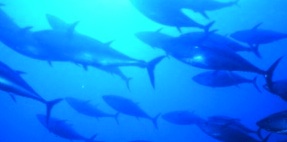
bluefin tunaI love tuna.

But do I love tuna enough to help stop it from going extinct?

According to CBC News: Tuna reviewed for endangered status

Canadian scientists are reviewing whether to list Atlantic bluefin tuna as an endangered fish, concerned the BP oil spill could tip the scales for the giant fish.

Scientists in the U.S. are also considering whether the tuna should be declared endangered. The odds against that happening in Canada are long. Canada has never listed a commercially fished saltwater species, not even cod….

The mention of cod above is instructive. Having lived on Canada’s east coast for nearly a decade, I’ve seen the cultural and economic impact of the collapse of the cod fishery there. Many people know about the collapse, which happened in the early 90’s, and most people probably know that it happened due to overfishing. That’s the simple story. Many standard accounts attribute the collapse to ‘factory’ fishing and to short-term thinking by the Canadian government. But the full story is more complex still, because the structure of the problem is a muti-tiered ‘tragedy of the commons, a “dilemma arising from the situation in which multiple individuals, acting independently, and solely and rationally consulting their own self-interest, will ultimately deplete a shared limited resource even when it is clear that it is not in anyone’s long-term interest for this to happen.” Why do I say “multi-tiered”? Well, because are really 3 ‘tragedy of the commons’ scenarios at play when it comes to overfishing, generally:

  • Between countries: Canada, the U.S., Portugal, Spain, and Iceland all benefited from fishing the north Atlantic for cod. If one had shown restraint and fished less, that would only have meant that the others would catch more. So each had a motive to go for more cod, rather than less — which is just what everyone did, with tragic results.
  • Between fishers: It’s been suggested that individual fishers understood, prior to government scientists, that the cod fishery was in trouble. But they had families to feed, so they had every reason to keep on fishing. Besides, an individual ecologically-minded fisher holding back would done have essentially zero to benefit the cod population as a whole.
  • Between consumers: Consumers like cod, and they like tuna, too. Personally, I know tuna is in jeopardy. What am I going to do? I could stop eating it — but would that matter? Probably not. If we all forego tuna, that will certainly work. But are we all going to? Maybe. But if you all do, then me eating tuna won’t do any harm. And if you all aren’t willing to help, me doing my bit won’t help either.

Now, that may sound defeatist, but if you want to understand the problems with the world’s fisheries you need to appreciate the underlying motivational logic. What about solutions? Well, education may help at the consumer level, but frankly I’m skeptical. Regulation would help, but as the CBC story points out, governments are loathe to put limits on a fishery that provides lots of jobs. Frankly, that’s understandable. International agreements can sometimes motivate governments to act — but we all know those are difficult to arrange and to enforce. It’s all quite difficult. The only thing I know for sure is that I really, really like sushi.

—-
FYI:
The Monterey Bay Aquarium Seafood Watch categorizes bluefin tuna as a fish to “Avoid,” noting that “All populations of bluefin tuna are being caught faster than they can reproduce.”

(Here’s more about the Northern bluefin tuna.)

Posted in aquaculture, ethics, fisheries, international, regulation | 6 Comments