Food Unites Us, and Tears us Apart

As my American friends prepare for Thanksgiving, it’s interesting to note the dual cultural tendencies of food to unite us and to divide us.

This past Sunday, over at my Business Ethics Blog, I posted what has turned out to be my most popular blog entry ever (most views in a single day), and it happens to be on food. Here it is: Can Employers Tell Employees What to Eat? It’s about a Montreal employer (a maker of animal-free handbags) that is insisting that its employees not eat meat on the premises. Many people think the ethical answer here is obvious, but they disagree on what the “obvious” answer is. Some think it’s “obvious” that employers can determine what happens on their own property; others think it’s “obvious” that no one should tell anyone else what they can or cannot eat.

The fact that this story made the news, and that it ended up being a popular blog item, suggest that what might have been thought to be a tempest in a teapot is actually something of a hot-button issue. The comments on my blog posting certainly suggest so.

Posted in choice, ethics, meat, values, vegetarianism | 1 Comment

Waste Not, Want Not: Nutria as Ethical Fur (and Meat?)

This story isn’t about food, really, but it could have been. It’s about the use of fur from the toothy beast known as the nutria (a.k.a. swamp rat) in the world of fashion, and the attempt to market its pelt as “ethical fur.”

By Anna Jane Grossman, for the NYT: Is Their Pest Your Clean Conscience?

[U]nlike other soft and furry animals, nutria is being rebranded as a socially acceptable and environmentally friendly alternative way to wear fur. The effort culminates this Sunday, when Ms. Melancon and about 20 designers take part in a “righteous fur” fashion show at the House of Yes, an art space in Williamsburg, Brooklyn.

Whence the ethics angle? Well, see in the swamps of Louisiana, the nutria is a pest — indeed, an ecological menace.

in the 1980s, the nutria population soared and started to endanger the fragile ecosystem. The invasive rodent eats away the bottom of the plants that hold the coastal wetlands together.

In 2002, Louisiana started paying trappers and hunters $5 for every nutria killed. The effort to control the nutria population had some success, with bounty hunters killing about 400,000 animals last year. But the carcasses were simply discarded or left to rot in the swamp.

The solution? Rather than let the rodents go entirely to waste, harvest their pelts and make them into coats, hats, etc.

OK, so the food angle? Wikipedia’s entry on nutria (also known as “coypu”) notes:

Coypu meat is lean and low in cholesterol. While there have been many attempts to establish markets for coypu meat, all documented cases have generally been unsuccessful.

So, if those who shun fur are tempted by the nutria’s “ethical” fur, are there vegetarians who would be tempted by the nutria’s “ethical” meat? Added bonus: as the story notes, nutria is organic and free range.

I’ll give the last (hilarous) word to an artisan quoted in the NYT story:

Jessica Radcliffe, a New Orleans dollmaker and performance artist, won’t use leather in her work but has made several nutria stoles. “I personally don’t want to be in a position where I have to kill an animal,” she said. “But if it’s them or us, I don’t want to be a lily-livered sissy about it.”

Posted in animal rights, ecosystems, ethics, meat, vegetarianism | 4 Comments

Are Self-Righteous Foodies Self-Defeating?

Here’s a lovely, thoughtful piece from NYT food blogger Peter Meehan: Grass Fed | A Few Beefs

The piece consists of 3 anecdotes. In each, Meehan — himself a serious foodie — is either subjected to, or sees someone else subjected to, over-the-top self-righteousness of someone who has appointed himself as a member of the Food Intelligentsia. One anecdote is about arcane terminology. The other is about coffee snobbery. The third is about relentless localism.

Meehan’s conclusion:

And I’m left to wonder: Is all this righteousness going in the right direction? Or will the snake eventually eat its own tail? What originally drew me to so many of these better-practice/better-flavor foodstuffs was the joy, the passion behind them. What I’m worried about is that as the food thing gets trendier and trendier, at some point the know-it-alls will scare off the casually interested. Maybe even their fellow foot soldiers. Is that sustainable?

It’s a great question. Anecdotes like the ones Meehan recounts make it even more tempting to see high-end foodie-ism as having more to do with status-seeking than it has to do with actually believing in a particular set of values. (For more on that line of thinking, see my interview with Andrew Potter, the author of The Authenticity Hoax, here: Interview: Andrew Potter and The Authenticity Hoax)

Posted in activism, ethics, local, meat, values | Comments Off on Are Self-Righteous Foodies Self-Defeating?

The Controversial Pom & Pistachio Magnates

Here’s an excellent piece on California philanthropists/fruit magnates Lynda and Stewart Resnick. By Susan Berfield, writing for Bloomberg Businessweek: A Pistachio Farmer, Pom Wonderful, and the FTC

On an unexpectedly rainy October day in Los Angeles, Stewart Resnick looks out the window of a third-floor conference room and shrugs. It’s midway through California’s biggest-ever pistachio harvest and the rain is yet another reminder, should anyone need it, of how important water is to his business. He helps himself to a half a vegetable wrap and a bottle of Fiji Water—one of the four big consumer brands Resnick owns—and takes his place at the head of the table, where senior executives of his private company, Roll International, have gathered to discuss how to sell 300 million pounds of pistachios….

It’s an interesting read throughout. I’m posting it here without comment, though the article raises lots of interesting ethical questions. The main ethical issues concern the Resnicks’ control over a substantial proportion of California’s precious water supply, and the FTC’s charges that the Resnicks’ company made false claims regarding the health benefits of their Pom pomegranate drink.

Here’s a bit about the FTC case:

The case against the Resnicks will be heard by an FTC administrative law judge in May; the couple expect to appeal to a federal court after that. They have already filed their own suit against the FTC, claiming that preventing them from publicizing the results of their studies violates their right to free speech. “We are consumed with doing good,” says Lynda. “That’s why this Pom stuff is so ridiculous. Please. We are fruit. Hello? Why do we need thousands of people in a 20-year trial for fruit? They do it for drugs because drugs kill people, or potentially harm them.”

But Berfield also quotes nutrition & food policy expert, Marion Nestle:

I love using Pom research as an example of how easy it is to design elaborate studies to give you the answer you want,” says Marion Nestle, professor of nutrition, food studies, and public health at New York University.

p.s. I’ve blogged about the Pom case before: Pom: Juice, Drug, or Something New?
——
Note (added June 1, 2012). Here’s a new blog entry I wrote about the legal judgment against POM Wonderful, from an ethics point of view: “POM Wonderful and hearts vs brains”

Posted in agriculture, ethics, farmers, FDA, health claims, regulation | Comments Off on The Controversial Pom & Pistachio Magnates

A (Uniquely?) Ethical Dairy Farm

When it comes to marketing food these days, few buzzwords seem to carry more weight than that simple 6-letter word, “ethics.”

See this story, from the BBC: A new ethical farm opens at Bhaktivedanta Manor

Hare Krishnas at Bhaktivedanta Manor in Hertfordshire have opened a New Cow Protection Centre.

The ethos of the new centre is to treat animals and the environment with the highest respect.

Cows at the New Gokul centre are raised in keeping with the Vedic method where nothing need be harmed to produce ample food for all.

The animals are played relaxing music, are hand milked and allowed to live their natural life span…

The farm’s dedication to animal welfare is what leads them to self-identify as “ethical.” According to a spokesman:

“These people [who will buy it] will know that when they drink this milk, that the cow is going to be living their full natural life span.

“Also, for the first six months, the cow’s calf will be able to suckle from her mother and get her complete fill every day,” he continued, “and then we will take what’s left, so there’s some real ethical farming that we’re trying to promote here….”

Now there’s nothing surprising about the fact that the farm’s operators identify their practices as “ethical.” Most of us do that. And that includes, presumably, the owners of factory farms — they presumably (though controversially) believe that their methods are, on the whole, ethically justifiable. Keep in mind that the word “ethical” isn’t a descriptive term. It’s evaluative. Calling something “ethical” implies a judgment about it. It doesn’t point to a style of farming, but rather to someone thinking that that style of farming is one that meets ethical standards. What’s more surprising here, though, is that the BBC’s headline writers credulously parrot the farm’s self-labelling.

Posted in agriculture, animal welfare, ethics, factory farms, religion | 3 Comments

US Government Contradicts Itself in Promoting Cheese

[Addendum (Dec. 14 2010) — it seems the NYT article cited below may have been misleading. See this blog entry here. Thanks to reader Anastasia for notifying me.]

I love cheese. Probably too much. If I ate as much of it as I would like, as often as I’d like, I would probably end up with serious health problems. But at least I know I love it too much, so I make a conscious effort not to go overboard. But it’s not clear that most consumers are conscious of the nutritional pros and cons of cheese, and enjoying it with suitable moderation.

And the American government is apparently not helping matters.

See this story, by Michael Moss, for the NYT: While Warning About Fat, U.S. Pushes Cheese Sales

….Urged on by government warnings about saturated fat, Americans have been moving toward low-fat milk for decades, leaving a surplus of whole milk and milk fat. Yet the government, through Dairy Management, is engaged in an effort to find ways to get dairy back into Americans’ diets, primarily through cheese.

Americans now eat an average of 33 pounds of cheese a year, nearly triple the 1970 rate. Cheese has become the largest source of saturated fat; an ounce of many cheeses contains as much saturated fat as a glass of whole milk….

With regard to Dairy Management, the NYT article says this:

The organization’s activities, revealed through interviews and records, provide a stark example of inherent conflicts in the Agriculture Department’s historical roles as both marketer of agriculture products and America’s nutrition police.

Interestingly, this is a topic on which the political left and right ought to agree. The left ought to see this as another example of government helping out Big Business. And the right ought to see this as another example of the government interfering in the economy, and an example of how doing so often does more harm than good.

Posted in health, junk food, marketing, public policy, USDA | 2 Comments

Fairtrade Coffee Battle

The British papers are having it out over fairtrade coffee this week:

Here’s the first volley, from Sean Poulter, writing for the Daily Mail: Unfair trade: Ethical food ‘is not lifting Third World farmers out of poverty’

Sales of its food have boomed on the back of promises that it delivers a fair price and decent working conditions to Third World farmers.

But Fairtrade products are failing to lift the farmers out of poverty, according to a study published today.

Less than 25 per cent of the price premium paid by shoppers for Fairtrade’s ‘ethical food’, such as coffee and chocolate, reaches the farmer, the controversial think-tank report suggests….

(The think-tank in question, by the way, is the free-market oriented Institute of Economic Affairs.)

And then, in response, there’s this piece by John Vidal, on the Guardian‘s “Poverty Matters” blog : A question for the fair trade critics: How much is human dignity worth?

Every self-respecting libertarian and free-market ideologue has to have a crack at fair trade. It’s like a rite of passage

But as someone who has visted fair trade projects in both African and Latin American countries, I can attest that it’s highly popular in the co-operatives it works with, and it makes a real difference to small farmers….

I’ve blogged recently about fairtrade coffee. See: Ethics and Economics (And Coffee Too), where I pointed out that, when you understand a bit about the economics of pricing, there’s reason for skepticism about the fairtrade notion. It’s not clear that schemes that involve consumers voluntarily paying extra can succeed promoting better outcomes overall, if that’s measured in terms of wealth. But Vidal’s piece in the Guardian rightly points out that such outcomes aren’t the only thing that matters, ethically. Justice and human dignity and treating people respectfully also matter.

Unfortunately, the Guardian piece isn’t as effective at making its point as it might be. It doesn’t, for example, tackle in any serious way the empirical claims made by the report, . While it’s true that promoting net welfare isn’t the only thing that matters, it certainly is an important factor. But instead, the piece mainly focuses on attacking the IEA and the people who wrote the report. It also wrongly implies that libertarians (a term it applies to the IEA) are against small enterprises and collectives, when in fact libertarians tend to love both (since they imply voluntary association with minimal government intervention).

I think that overall it’s still pretty unclear what consumers should think of fairtrade coffee. It’s not clear to me that, as a generalization, buying fairtrade is an effective way of making the world a better place. But I don’t think it’s necessarily a bad thing, unless of course it allows consumers to fool themselves into thinking they’ve helped more than they have.

Posted in certifiction, ethics, fairtrade, labeling | 1 Comment

Food Eco Labels vs Legislation

When is choice good? Do labels do enough to help us make good choices? When is legislation required? Should legislation facilitate good decisions, or force them?

See this story, by Harry Wallop, for the Daily Telegraph: Food eco labels not robust enough, study finds

Labels on food, drinks, electrical gadgets, furniture and paper that boast about their environmentally-friendly credentials are frequently confusing or misleading, according to a study undertaken on behalf of the [U.K.] Department for the Environment, Food and Rural Affairs.

Too many of the labels, which range from food assurance schemes such as Red Tractor to campaigning groups such as the Marine Stewardship Council and Soil Association, do not guarantee that the farmer or the retailer, has mitigated any harmful effects on the environment.

Instead, they merely insist that the producer has “followed best practice”….

The Report’s solution? Legislation.

Its conclusions…suggest that labels, nearly all of which are voluntary schemes, are less effective than legislation.

A spokesperson for the Food Ethics Council (a co-sponsor of the Report) is quoted as pointing out that legislation can (and, in her view, should) narrow the range of choices open to consumers:

“Labels can help consumers make a choice, but they are only part of a package of measures, including regulation and ‘choice editing’. After all, nobody buying clothes on the high street expects them to have been made by a child – so why should consumers have to make a decision about whether the prawns in their trolley have helped destroy the marine environment?”

This is actually a useful way of describing a whole range of issues: governments (and other institutions) narrow the range of options open to us, and we individuals choose from within that range. But the spokesperson’s latter question (why make choose?) is one that bears a lot of unpacking. First, it’s interesting that she makes her point in terms of “making” consumers choose (rather than in terms of “letting” them choose). More neutrally, then, why give consumers choice? Well, generally choice (i.e., freedom) is good. That’s not to say that we should allow people unlimited opportunities to choose to do bad things. But if we’re going to narrow, by legislation, the range of options available to people, we do need at least to be sure about the basis for doing so. And that means two things. First, we need some clear set of facts (about, e.g., the environmental impact of various food-production processes). And second, we need a fair bit of moral consensus regarding how bad those impacts are, as well as about the tradeoffs involved in reducing them by means of limiting consumer choice.

Posted in certifiction, choice, environment, ethics, labeling, regulation, values | Comments Off on Food Eco Labels vs Legislation

Endangered Dinner DNA

Earlier this month, the print version of Popular Science ran a really interesting story on using genetic technology to fight the traffic in endangered species. Here’s the web version:
Is Your Dinner Endangered? DNA Detectives Investigate

In the ongoing campaign to protect endangered animals, forensic investigators can already identify the food on your plate. Now they are working on advanced methods of intercepting even the most carefully disguised contraband – be it tuna, caviar or bushmeat. Their ultimate goal: pinpoint where the goods came from, and stop the hunting of endangered species at the source….

One of the things I found most interesting in the story was the idea that this technology represents a double-edged sword:

But identifying what is on the plate will not in itself protect endangered animals. After all, many people will want to authenticate bluefin, or monkey meat, or whale, or something else precisely so they can eat it….

In other words, if you want to verify that the black-market food you’re buying really is from that endangered species (and hence worth paying big bucks for — remember that scene from The Freshman?) DNA evidence is just the ticket.

Just today, ABCNews featured this Reuters story about the Canadian-based International Barcode of Life Project (iBOL) : DNA Barcoding Aims to Protect Species and Food. According to this story, the database contains:

87,000 formally described species with barcodes filed and more than 1 million total barcoded specimens….

For now, of course, the technology required to read such a genetic “barcode” is extremely sophisticated, and thus limited to research labs and border protection agencies. A technology that will allow you to check the provenance of your sushi by means genetic means seems a long way off. But then, at the pace of technology today, who knows?

Posted in endangered species, environment, fisheries, genes, international, regulation, science | Comments Off on Endangered Dinner DNA

Beer as Taxidermy

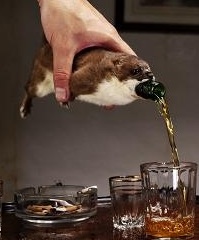
I guess if you’re going to push your luck in terms of social objections to your product, you might as well push hard. In particular, if you’re going to produce a beer (typically a low-alcohol beverage) with 55% alcohol, you might as well package it inside the skins of dead animals. That way you can get PETA and the international temperance movement upset all at once.

From the online brand magazine, POPSOP: BrewDog Sells the Strongest Beer Ever in Stuffed Animals

BrewDog is stepping beyond the boundaries of beer brewing and… common sense. Following the launch of its 41% “Sink The Bismarck!,” the Scottish indie brewery is releasing its limited edition taboo-breaking 55% beer in bottles, which are stuck into dead animals’ bodies….

Now, apparently, “all the animals used were road kill.” So maybe animal rights activists won’t be alarmed after all. But then — as is always the case with beer anyway — there’s the question of taste.

Posted in alcohol, animal rights, ethics, marketing | Comments Off on Beer as Taxidermy